Sonntag, 10. Dezember 2023

FREE ON CINEGEEK.DE Brian de Palma - Blow Out 


Blow Out by Brian De Palma seems strangely familiar and also quite strange. The paranoia thriller was constructed from some events of recent American history, thickened with references from other films and by other filmmakers. Nevertheless: Blow Out is an independent, phanatastic achievement! The title is reminiscent of one of the greatest 60s classics. The story in which a photographer takes a picture of a corpse and finally analyzes his photos for the find. Was there even a dead body on the negative? In Blow Out John Travolta plays the character who is confronted with the same questions. He works for a greasy B-movie production company in Philadelphia. He makes cheap cynical exploitation films - according to De Palma's taste! One night he stands at a bridge in the park. The cry of an owl and similar noises fill the night he records. Suddenly he witnesses a car accident! The car crashes off the bridge, a blowout. Travolta jumps behind, saves a girl (Nancy Allen) and later finds out that the driver of the car was a presidential candidate. Listening to his tape, he thinks he heard a shot just before the accident. Is it a murder? He follows the trail of Nancy Allen, finds out that she was a helper in a blackmail. It's wonderful how the plot now condenses! Apparently De Palma doesn't just have a handful of ideas, he floats in abundance! We meet a series of violent characters like Burke (John Lithgow) as Travolta's character gets deeper and deeper into the swamp of a conspiracy. Something personal is at stake for him: his ability as a sound engineer and his personal pride! "I'm a sound man!" In the best Blow Out scene, he recreates all the events of the night. He follows the tracks of his own recording. De Palma's technique follows that of the greatest thriller specialist of all time. It hitchcocks really powerful! Numerous references like the shower scene are dedicated to the "Master of the Macabre" (De Palma). He gives a whole series of ugly murders in unusual surroundings and a hunt through Philadelphia while Liberty Bell strikes for the big jubilee. Two strategies of "Hitch" are used here: First his patriotically charged images, then the desperate hunt within a human mass that cares for the individual but not further. However, De Palma's film takes all this away and so Blow Out stands alone. The desire for exaggerated violence and nihilism, the sexual insinuations, quite naturally alongside the postmodern quote cinema - all this is Brian De Palma! But you hate or love him. So he unites the cinephiles with the onlookers! Note: As in his best films, De Palma fills the action with three-dimensional plausible, even interesting characters. We like to believe that characters like John Travolta, Nancy Allen or John Lithgow are real. They all have these little quirks, the quirks of life. For me, that's the difference between a good De Palma movie and a big one: The characters! De Palma often uses stencils to throw himself at his beloved surface stimuli. In Blow Out he goes to as much trouble as he does in his greatest works! The protagonists really behave like people in similar situations. They don't just follow the requirements of a plot! But the most beautiful thing: Blow Out is held together by real cinematic intelligence. In scenes like this, where Travolta is following the accident, we are taken on a journey of discovery. We are allowed to find out what he is reconstructing! At last we are more than just passive witnesses of the events - and that really doesn't happen so often in the cinema.

Sonntag, 3. Dezember 2023

FREE ON CINEGEEK.DE Yasujiro Ozu - Tokyo Twilight 


 The hat on the wall hook, the whiskey bottle, the steam from Ozu's teapot - all of these symbolise loneliness in Ozu's cinema. Abandonment, transience. And if you look carefully at Tokyo Twilight, the story of a father (Chishū Ryū) and his two grown-up daughters Takako (Setsuko Hara) and Akiko (Ineko Arima) and their long-lost mother, you will realise how courageously such themes as suicide, alcoholism, abortion and abuse resonate here. Ozu's latest black and white film treads dark territory. Who knows, maybe that's why Tokyo Twilight never appears in Ozu's retrospectives? Ozu remains true to his style. His low shots at eye level and the absence of panning shots. He also remains true to his theme, the family. But everything here is much darker. Anyone who reads contemporary reviews will learn of Ozu's greatest failure. Tokyo Twilight is set in winter, whereas Ozu normally favours the other seasons. The film plunges into the shabby milieu of Tokyo. Then Tokyo Twilight crosses a line: one of the two adult daughters becomes pregnant - out of wedlock. Why did she go astray, asks the other sister? We learn that her mother left her when she was young. That's why she became so "wild". The film itself never judges. It always remains reserved, never savours the daughters' grief, but observes calmly. It is empathetic and accepts its characters.

Freitag, 1. Dezember 2023

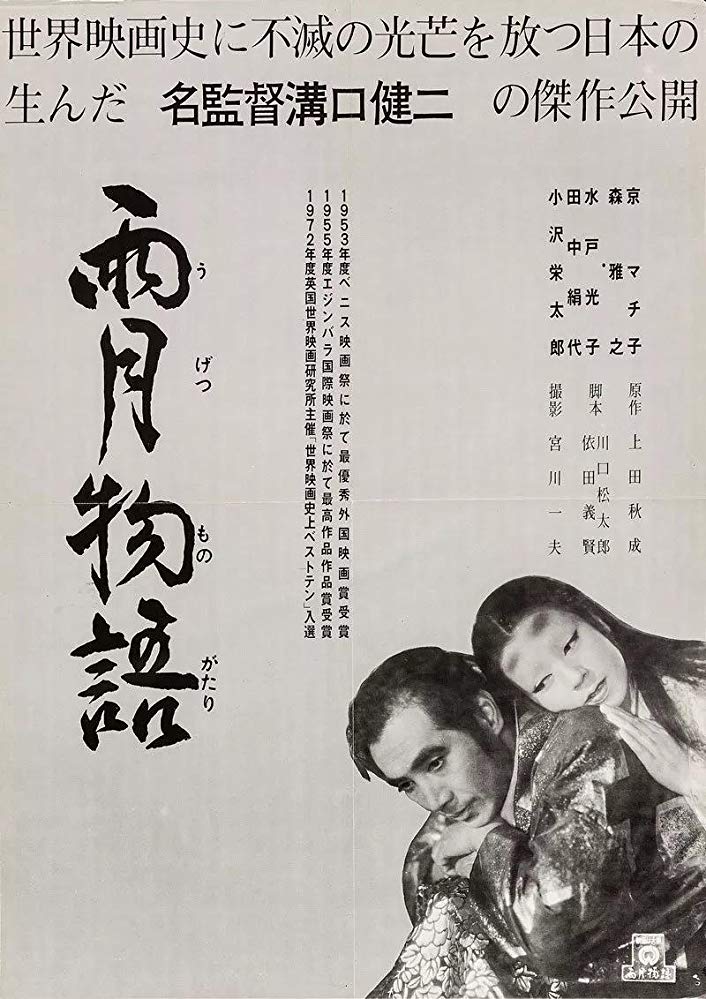
FREE ON CINEGEEK.DE Kenji Mizoguchi - Ugetsu 


Two brothers, one greedy, the other envious. During a time when the land was devastated by vagabond soldiers, they risk the welfare of their families, risking their lives by pursuing their interests. Kenji Mizoguchi tells her story in this great film - one of the best ever! Although his heroes are rough and uncouth, Ugetsu is a work of elegance and mystery. Even before it becomes clear, we feel that Ugetsu is a work of elegance and mystery: Ugetsu is also a ghost story. Ugetsu is opened by the landscape passing us by, even being rolled up - like a Japanese drawing or a scroll. We see a village. Heavy branches lie on the roofs of the houses so that the wind does not carry the roofs away. We get to know Genjuro (Masayuki Mori), a potter and Tobei (Eitaro Ozawa), a farmer. Shots fired from afar, the army approaches. Genjuro's wife begs him not to ride into town. Not in these times! She asks him to protect her and her son. But with the excitement of a fool, Genjuro insists on the ride. Tobei, just as crazy, insists on accompanying him. Genjuro returns with gold coins. He has captured a factory in the city. His wife, on the other hand, tries to make it clear to him that new clothes could never outweigh her love for him. But Genjuro has only one thing in mind: money, money and even more money. Almost furiously he gets back to work. Tobei meets a great samurai. He would like to ride along, but is chased away as a stupid farmer without armour. Soon the two men decide to go into town again - out of fear for their possessions. This time they want to cross the lake in a boat because it seems safer to them. The scene at the lake, it's the most wonderful one in the whole movie! In front of us a world full of haze and fog. The lonely boatman gives a warning of pirates. Genjuro leaves his wife and child behind at the coast, Tobei accompanies him. In the city Genjuro's work quickly pays off and so he is invited to the castle of the beautiful Lady Wakasa. She is impersonated by Machiko Kyo, one of the greatest Japanese stars ever! Meanwhile Tobei also leaves his family alone. Stupid and clumsy as he is, he kills a samurai and steals a skull. Thanks to this trophy he is honored by the top samurai with a following. The troop's way leads to the house of the Geishas, where Tobei finds out that his wife was raped and abducted by soldiers. She now works as a geisha. Meanwhile Genjuro is spellbound by Lady Wakasa's appearance. Her beauty, which, he says, is unparalleled in the world! Lady Wakasa praises the simplicity and perhaps he should have felt warned because he hears the voice of her dead father. He is whispered to leave his village and marry the beautiful one... Mizoguchi held the theory that a scene should be filmed in a shot. We know this view from great Japanese films of the time with the difference that Mizoguchi's camera never stays. It seems to float, moving through space, which is as beguiling as it is poetic. Morbidly the scenes in Lady Wakasa's castle as a priest sees Genjuro's face. Frightened, he stammers, one would see death in it! Something is there on his skin! They are symbols of an exorcism! Of course Lady Wakasa is a ghost, which we never doubted. Finally we also realize that her castle is in truth a ruin. In Ugetsu, however, there is a second spirit that appears quite unexpectedly. Just at the moment when both men return to their village and hope for forgiveness from their wives for their male blindness... The characters in Ugetsu are down-to-earth. But I would understand it as a comic character. However, the story itself seems to be taken from the old days of Japanese ghost theatre. Unlike western horror movies, Mizoguchi never tries to scare us. It's something else that drives him. Something very kind! At the end we saw a fable, but we also witnessed the ordinary life.

Samstag, 11. November 2023

German Films 10s - Film List on CINEGEEK.DE 


The great phases of German film during the Expressionism of the 1920s and the New German Cinema of the 1970s seemed strangely mannered and artificial. German films loved unusual colours and lighting ratios, willing to follow their characters to the limits of human behaviour. This deliberately artificial dimension can still be found in the productions of the 10s, albeit only sporadically.

Freitag, 10. November 2023

FREE ON CINEGEEK.DE Alain Resnais - Night And Fog 


Never again! (Please do not misuse this post for anti-Semitic posts and nonsense). On 9.11.38 Nazi gangs rampaged through the streets of Berlin. The so-called Reich Pogrom Night. Over 90 years old he became. His career lasted over six decades and he always had his finger on the pulse of his time: Alain Resnais. He became famous in 1955 with this documentary about the German concentration camps. Even today my father tells me how they showed Night And Fog at the film club. Some long-time members resigned as a result. They felt attacked by the young "Beatnicks" and their disrespectful films. Especially in Germany of the 50s Night And Fog must have been a brutal experience. And it still works today! Resnais was one of the very first to take up the subject of Nazi concentration camps. He invented a new technique to combine black and white images from the archives with color images of the abandoned camps. Right at the beginning we lose the ground under our feet. A supposedly safe room turns into a dangerous one. Crash. Below an idyllic landscape a barbed wire comes to light. Finally this barbed wire is the foreground. If we previously felt a feeling of satisfaction, this is now lost. The narrator comments: "A concentration camp is built like any stadium or a hotel". Even a church can lead to a concentration camp. We understand: Any place can be charged with hate and anger and xenophobia. In the following there will be nothing else but the Holocaust. No way to distract our gaze. The catastrophe becomes tangible and accompanies us through the montage of the film until the present day: "Are their faces really so different than ours?

Montag, 6. November 2023

FREE ON CINEGEEK.DE David Lean - Lawrence Of Arabia 


What kind of daring genius did it take to produce this film? An epic four hours long without stars, without a love story and without much action. The hero is the eccentric, even suicidal T.E. Lawrence, who survives an almost impossible journey through the desert. Already safe, he returns to find his friend, who stayed behind. We know the scene. A spot appears far back on the horizon. A spot that becomes a man. Or don't we know this moment at all? If you rent the DVD from us or stream the film you will hardly identify the spot on the TV monitor. I'm sorry, but this is a movie! A 70mm movie! Only in the 70mm format we can get an impression of the vastness of the desert. Lawrence Of Arabia is not a simple historical film. It is a work about the extravagance of the desert. It is proven: Lawrence won the Arabs to fight for the British and against the Turks. Did he do it out of patriotism? The film corrects that. No, rather out of pragmatism. Basically, he rejected the British side and identified with the Arabs. Or is it true that Lawrence was homosexual? Of course, this aspect had to be treated carefully in such an expensive epic in 1962. Peter O'Toole plays Lawrence. A frail beautiful actor. Not an ordinary action hero, but one who still wanted to be recognized. What secret did this Lawrence hide? He speaks in a strange manner, seems as charismatic as he is crazy. How could he get the Arabs to follow him through the desert? O'Toole plays at least one socially and sexually unconventional man. Could such a man win the war against the Turks? He could. Without realizing their rivalries, he allied himself with the desert lords Sherif Ali (Omar Sharif), Prince Faisal (Alec Guinness) and Auda Abu Tayi (Anthony Quinn). Strangely enough, the following epic is based less on "plot" than on "feeling". The story is not told in dialogues, but in the recordings of the desert. Epos refers not so much to the elaborate production, but to the unique artistic vision! Unfortunately, we can't offer this vision in our video store. You must try to see it somewhere on 70mm. A task almost as difficult as the production of Lawrence Of Arabia!